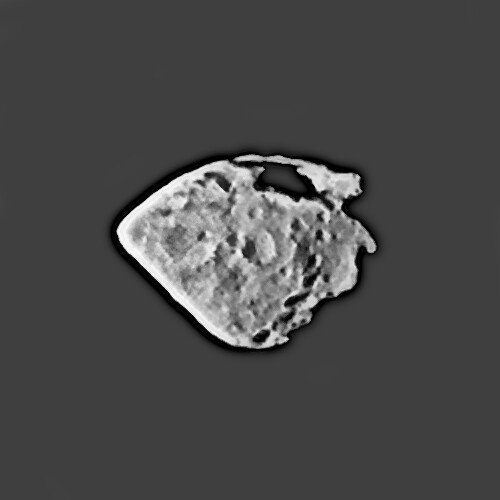
Four years after NASA intentionally slammed a spacecraft into an asteroid to test whether humanity could defend itself from a cosmic collision, a new probe has arrived at the scene to assess the damage. The European Space Agency’s Hera mission reached the Didymos asteroid system this week, with its first images expected soon.
In 2022, NASA’s DART spacecraft barreled into a 150-meter-wide (490-foot) asteroid called Dimorphos at roughly 22,000 km/h (14,000 mph), destroying itself on impact but successfully nudging the space rock off course. The collision kicked up a debris trail stretching about 10,000 kilometers (6,200 miles), visible from telescopes on Earth, and shortened Dimorphos’s orbit around its larger companion, Didymos, by about 33 minutes.
Now Hera has arrived to pick up the investigation where DART left off. Scientists describe the mission as a kind of detective returning to the crime scene: because DART was destroyed on contact, researchers still don’t know exactly what the impact left behind — whether a crater, or a completely reshaped asteroid. Hera, equipped with scientific instruments and two shoebox-sized mini-satellites, will spend roughly a year measuring Dimorphos’s mass and structure to determine just how effective the original strategy was.
The findings could prove crucial if astronomers ever detect a genuinely dangerous asteroid headed toward Earth, helping them calculate exactly what kind of spacecraft, speed, and timing would be needed to push it safely off course.
Curious about the full story? You can read the original report from the BBC.
Source: Four years after huge asteroid crash, a spacecraft has now returned to assess the damage (feeds.bbci.co.uk).
Image: europeanspaceagency, BY-SA 2.0 (via Openverse).